These records are found in the online catalog of The Mariners’ Museum and Park in Newport News, Virginia. Uncurated search results are presented to give researchers and interested readers an idea of whether the museum’s archives contain information about this vessel and whether it may be worthwhile to visit the museum’s catalog search page for further investigation. Uncurated results may be inaccurate or incomplete.
Mariners Museum online catalog search, July 12, 2026. Search phrase: "Etta". Catalog returned 10 records; this selection table includes 10 records fetched through catalog result pages.
Use these buttons to send uncurated search results to your own app or text document for further research. First, check the box for any row, or click "Select All" then uncheck any rows. Then click "Show Selections". You can then copy your selections from the text box and past them into your app.
E-11371 - Lt. Kennedy, 0-507195, from Troy, N.Y. and Sgt. Dickinson, A-900578, from California, are shown playing Santa Claus at the Motor Pool Xmas party. Photo taken at HRPE, Newport News, Va. 12-21-44
A scene during the Christmas party held at the motor pool. Lt. William Kennedy and Sgt. Marjorie Dickinson are handing out gifts from under the tree to other party guests.
L7069 - Seven Army Nurses formerly attached to HRPE on USS Gen. W. Mitchell. 3-27-44 Official Photograph, U. S. Army Signal Corps, HRPE, Newport News, Va. "SECRET Authority WD Cir 346 October 15, 1942 Initials WCS Date 3 APR 1944" stamped in red ink.
Embarkation (Military science).
A group of Medical Corps WACs in uniform are seated together on board ship.
The negatives in this collection depict a variety of steam vessels of many different steamship companies, including side wheel steamers, screw schooners, ferries, and steamships. Typically these vessels are shown in motion but a handful appear moored in a harbor. Most of the negatives do not include geographic information, but it is known that Stebbins was most active in New England, especially around Boston, extending along all of America’s east coast. Furthermore, the negatives themselves are not dated, thus photographs have been dated as after the vessel launch date. According to the custodial history recorded by Historic New England, after Stebbins’ death his equipment and collection of glass plates became the property of his associate, the photographer Edward U. Gleason. Stebbins’ collection remained with Gleason until his death in 1928 at which point it was broken up. The collection held by The Mariners’ Museum originally came from Gleason after 1928. The collection consists of 83 negatives arranged in alphabetical order by vessel name. There are 82 glass plate negatives, most are 10 x 8 inches, and some show signs of acid burn or flaking of emulsion. One glass plate, item 77, is broken and its fragment is kept in a separate envelope. One additional image, item 19, has no glass plate. It is represented by a silver gelatin negative and an interpositive.
SANTA CATALINA ISLAND - AVALON - CALIFORNIA - UNITED STATES - Related Place
NOTES: Description of history associated with the same print for sale at Barry Lawrence Ruderman Antique Maps: Juan Cabrillo originally discovered and claimed Catalina Island for Spain in 1542. In 1602, Sebastian Viscaino named the island Santa Catalina. The Portola expedition also claimed the island for Spain in 1769. The Spanish began to step up their efforts to colonize California by establishing a chain of missions up and down California. Trading with foreigners was prohibited by law and Catalina Island proved a safe place for smugglers. Sea otter skins were highly sought after for the China trade and the otters were hunted to extinction in Catalina waters. In 1805 an American sea captain and trader named William Shaler beached his ship on the island for repairs and wrote that the Indians were friendly and helped him. Following Mexico's independence in 1821, Catalina and California were under Mexican jurisdiction and the secluded island continued to be a popular place to hide from the authorities. The Mission system declined and was secularized in 1834. The Mexican government gave away huge tracts of mission lands to favored individuals. In 1839, a naturalized Mexican citizen named Thomas Robbins made his first petition to Mexican governor Pio Pico to be granted the island of Santa Catalina (no mission had ever been built on the Island). Governor Pio Pico finally granted his wish on July 4, 1846, just days before the Americans went to war with Mexico. By 1848. Robbins had established a small rancho at the island's isthmus. He moved to Santa Barbara and subsequently sold the Island. Catalina changed hands many times. Following the discovery of gold in California in 1848, some minors made it to Catalina in a short-lived flurry of mining activity. Instead of gold, they found galena, an ore of silver, lead and zinc. In 1864, Union soldiers were dispatched to the Island to see if it would be suitable for a reservation for Indians from Humboldt County. All miners without substantial claims were forced to leave the island. Within a year the idea was abandoned and the soldiers left. From 1858 to 1867 a number of different people shared ownership of the island. By 1867, millionaire James Lick of San Francisco gained full ownership and evicted all the squatters from the island. When Lick died in 1876, his trustees took over the estate and in 1887 sold the island to George Shatto, a young businessman who had recently come to Los Angeles from Michigan. Shatto decided to develop the Island as a tourist resort, establishing a town in a beautiful sheltered valley with wide, crescent shaped harbor on the northeast side of the island. He enlarged the existing wharf to accommodate larger steamers, and built the Hotel Metropole. He had the town surveyed, and sold the first lots. Shatto's sister-in-law Etta Whitney chose the name Avalon for the town. Shatto proved unable to make his mortgage payments and the island reverted to the Lick Trustees. In 1892, they sold the Island to the Banning brothers. Their father Phineas Banning was a visionary who forged transportation and communication networks in Southern California. He was instrumental in the development of Los Angeles Harbor and the founder of Wilmington. His sons William, Joseph, and Hancock, assumed responsibility for many of their father's business interests. They took over the Wilmington Transportation Company in 1884, which provided more and more steamers to transport people to Catalina. Two years after purchasing the island they established the Santa Catalina Island Company and placed the land holdings that they had acquired in 1892 into the newly formed corporation. The Banning's built roads in the Island's interior, and installed the first telephone and wireless telegraph systems. They also built several tourist attractions to insure Avalon's continued success as a resort town, including two dance pavilions, a band stand, an aquarium, a Greek amphitheater, an inclined railway to take people from Avalon to Lover's Cove, and a golf course. They offered fishing excursions, sight-seeing by stagecoach, and glass bottomed boat trips. Around the turn of the century the island became world-renowned for sport fishing. Elevating fishing to a sport was a new idea, promoted in large part as a conservation effort by writer and naturalist Charles Frederick Holder, who popularized the use of light tackle. He founded the Tuna Club, which established strict rules for anglers. In 1913, Avalon became an incorporated city. In November of 1915, a devastating fire burned out of control for three days, destroying about a third of the town, including the Hotel Metropole. The Banning brothers built the elegant Hotel Saint Catherine to replace it, but were unable to recover their financial losses. In 1919, they sold the Island to William Wrigley Jr. William Wrigley Jr. bought the island sight unseen. He enlarged the fleet of cross-channel steamers, adding the S. S. Avalon, as well as the S. S. Catalina which he built specifically for the Catalina run. He constructed a power plant, improved the sewer system, and gave the island a source of fresh water by building reservoirs in the island's interior. In 1920 he built the Hotel Atwater and in 1928 built the Bird Park with thousands of exotic birds on display to the public. Wrigley also built Avalon's famous Casino, which housed a state-of-the art theatre and ballroom. At that time the word Casino was used generally to mean "a place of entertainment." At a cost of $2 million, the Casino took 14 months to build and opened in 1929. Wrigley promoted the island through well-publicized events such as the 1927 Wrigley Ocean Marathon swim and world-class golf tournaments on a renovated 18-hole course. He owned the Chicago Cubs and brought them to the island for spring training. After Wrigley's death, his son Philip continued to develop and expand Catalina. In 1975 the Wrigley donated 88% of the island to the Catalina Island Conservancy, a nonprofit corporation with a mission to "preserve and restore Catalina to its natural state in perpetuity so that future generations can continue to enjoy this unique part of California's heritage."
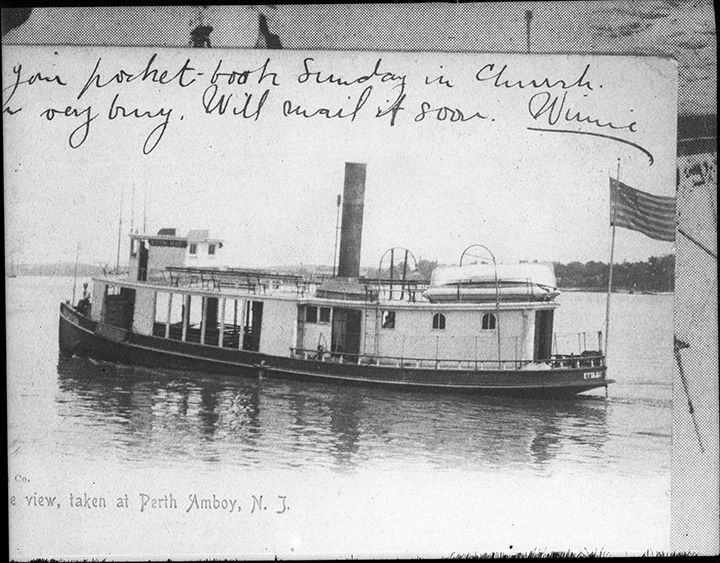 MS0091-03-01-20-009
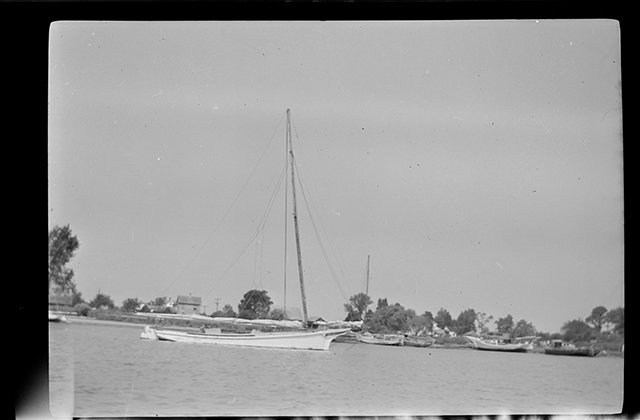 MS63-534 Batteaux Etta
 P0003-01 - E-11371
 P0003-01 - L-7069
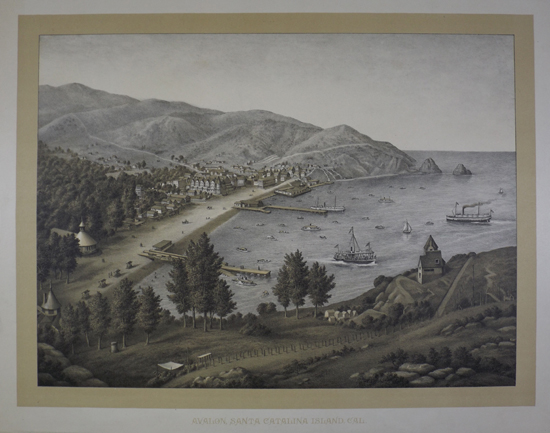 lp4357